Legacy SIEM gives you a log bucket and a rulebook. Modern threats need an Integrated Security Operations Center — detection, investigation and response unified on one open, behavior-driven, AI-native platform. Collect everything. Catch what rules miss. Resolve at machine speed.
These aren't tuning problems — they're architectural. They're why mid-to-large SOCs are migrating off rules-and-index SIEMs.
Bounded queues with no guaranteed-delivery caching layer. Spikes happen during incidents — so the platform discards high-value evidence exactly when an attack is live, with no replay to recover it.
Events keep vendor-specific field names. Normalization is an external bolt-on, so detections and dashboards can't be ported — and ML can't reason across inconsistent fields.
The index becomes the scaling ceiling: query performance degrades under load, field-mapping conflicts silently fail ingestion, and cost-per-GB forces you to under-collect.
Correlation engines lack true nested, multi-level correlation. Complex, cross-domain attack chains slip between the rules.
On-prem tenant separation is UI-level only, with global rulesets and no tenant-scoped isolation — forcing MSSPs into fragile workarounds.
Endless decoder tuning, rule maintenance, indexer ops and manual scaling. The hidden cost of "free" SIEM is sustained engineering toil.
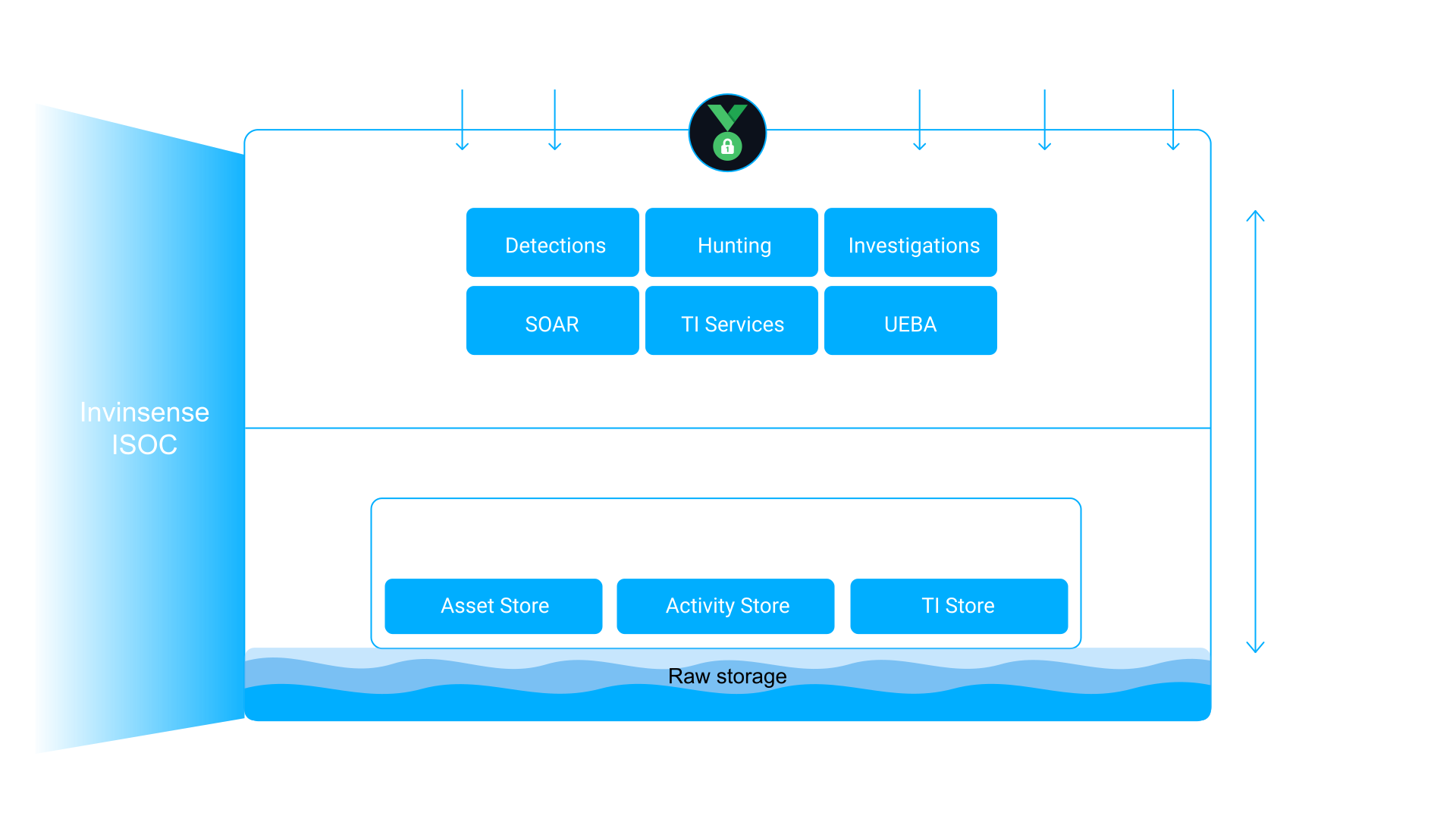
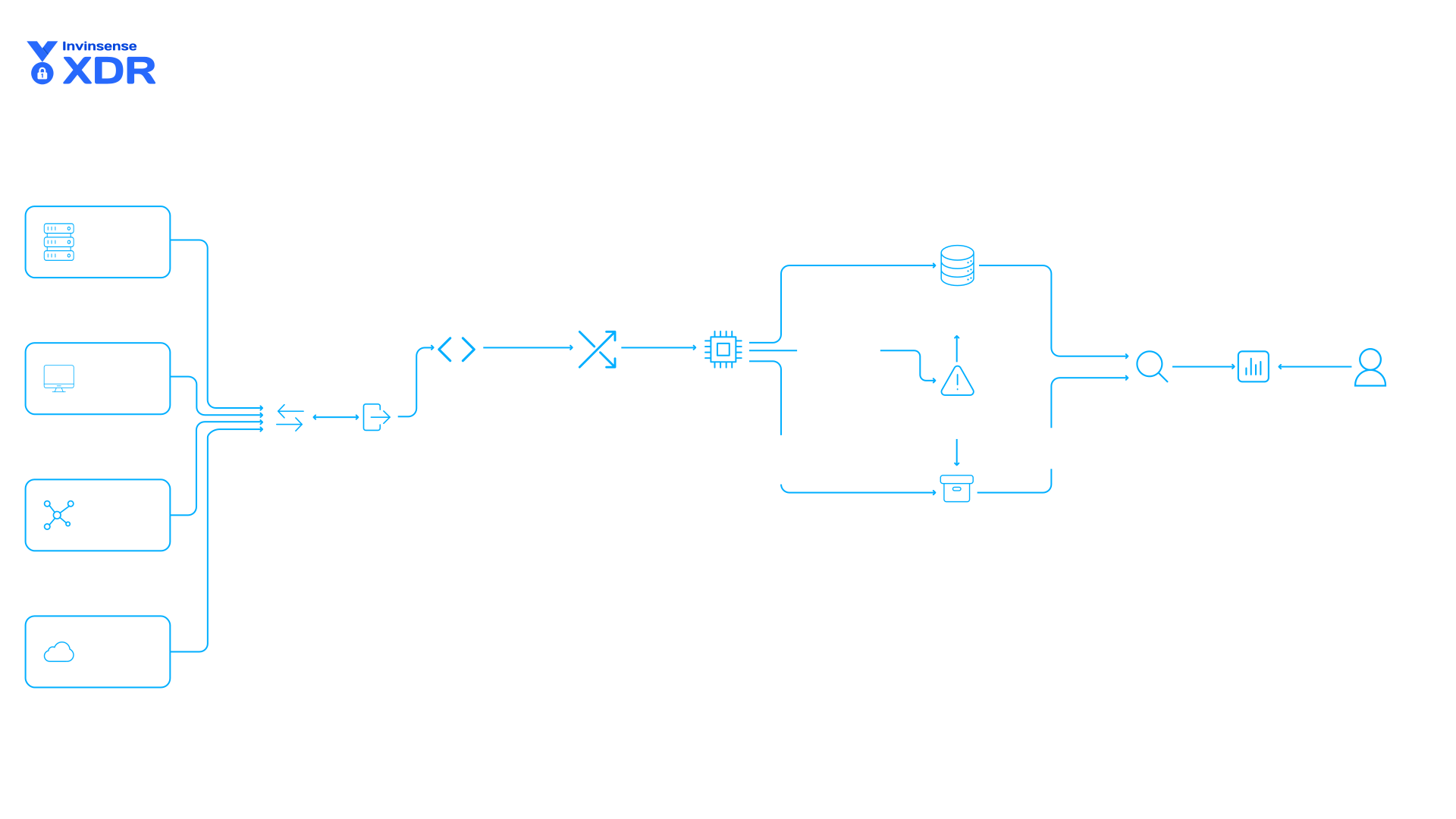
Watch telemetry flow under load. Legacy queues overflow and silently drop evidence. The ISOC buffers, normalizes to OCSF, and lands everything in your data lake — searchable, AI-ready, nothing lost.
Rules ask "did this exact thing happen?" Behavioral ML asks "is this normal for this user, host or identity?" — the only way to catch zero-days, insider threats and lateral movement that signatures miss.
As buyers diverged, the TDIR market separated into three approaches. Only one removes complexity by converging the entire stack.
Maximally extensible and open. Built for large, mature teams that want deep customization across many third-party controls.
Data management first. Decouples a lake/lakehouse for huge ingestion at controlled cost — strongest where volume is the limit.
One vendor delivers the whole stack — SIEM + UEBA + SOAR + TI + AI SOC agents — operated as a single system.
Each mandatory ISOC capability maps to a native Invinsense module, governed by a single control plane and console.
ML & UEBA score risk by context to surface known and unknown threats — beyond static rules.
AI triage, hunting and response agents work 24/7 with human-in-the-loop decision authority.
Normalize to OCSF on ingest; filter, route and tier data to slash cost without losing visibility.
Decoupled analytics over your data lake of choice — SaaS, cloud, on-prem or hybrid. No lock-in.
Automated, agentically-adjusted playbooks orchestrate response across every control point.
Continuous threat exposure management correlates exploitability with real behavior, not just CVSS.
Automated Moving Target Defense and decoys throw attackers off the scent — pre-emptive, not reactive.
Federated search, NLP querying and cross-product case management unify the whole investigation.
| Dimension | Traditional SIEM | Invinsense ISOC |
|---|---|---|
| Detection model | Static correlation rules | Behavioral ML + risk scoring |
| Architecture | Monolithic, storage-coupled | Cloud-native, decoupled |
| Data normalization | ✕ bolt-on / none | ✓ OCSF on ingest |
| Storage | Proprietary index, pay-per-GB | Bring-your-own data lake |
| Ingestion reliability | ✕ drops under load | ✓ buffer + replay |
| Tooling | SIEM/UEBA/SOAR bought separately | One integrated system |
| Response | Manual, config-file driven | Agentic AI, human-in-loop |
| MSSP tenancy | ✕ UI-level only | ✓ end-to-end isolation |
| Content portability | Locked to vendor fields | Open schema, portable |
| Cost driver | Ingestion volume | Usage-controlled pipeline |
A real intrusion crosses identity, cloud, SaaS, endpoint and on-prem. Rules see five disconnected alerts. The ISOC connects them into a single, risk-scored incident.
Federate analytics across globally dispersed AWS, Azure, GCP and SaaS estates. Correlate a campaign crossing cloud → SaaS → on-prem in real time.
Baseline every identity, flag over-privileged accounts, rogue credentials and subtle lateral movement before attackers reach the crown jewels.
AI agents perform L1 triage and evidence-gathering at machine speed, escalating with full context while analysts keep decision authority.
Route raw logs to low-cost cold storage that stays searchable — meet retention and compliance without bankrupting the budget.
Map ML detections directly to NIST 800-53, PCI DSS, HIPAA, ISO 27001 and MITRE ATT&CK — a continuous state, not a fire drill.
Natural-language querying across the whole data ecosystem — hunt across data you don't even store inside the SIEM.
Most SIEMs only watch. Infopercept built Invinsense to think like the adversary and defend like an operator — fusing offense, defense and compliance into one pre-emptive ISOC. That adversarial DNA is what makes us a visionary, not a check-the-box vendor.
Offensive engineering embedded in the platform — detections built around how attacks actually unfold.
Behavioral analytics, agentic AI and unified response turn signal into resolved incidents at machine speed.
// offense + defense + compliance — converged into one Integrated SOC
SIEM
Security information & event management
SOAR
Automated orchestration & response
EDR
Endpoint detection & response
TI / TE
Threat intelligence & emulation
Case Management
Incident tracking & workflow
AI Powered
Adaptive AI-driven analysis
NDR / CDR
Network & cloud detection & response
Network Deception
Honeypots & decoy-based trapping
AI Firewall
Intelligent perimeter protection
Illustrative targets — replace with Infopercept's own validated benchmarks before publishing.
Discover how the Invinsense ISOC reduces risk, gains agility and cuts data cost — meeting you where you are, across SaaS, cloud, on-prem and hybrid.
Discover complete cybersecurity expertise you can trust and prove you made the right choice!